Home Ā» Discover the new Canon label printers
New brand in our catalog : Canon
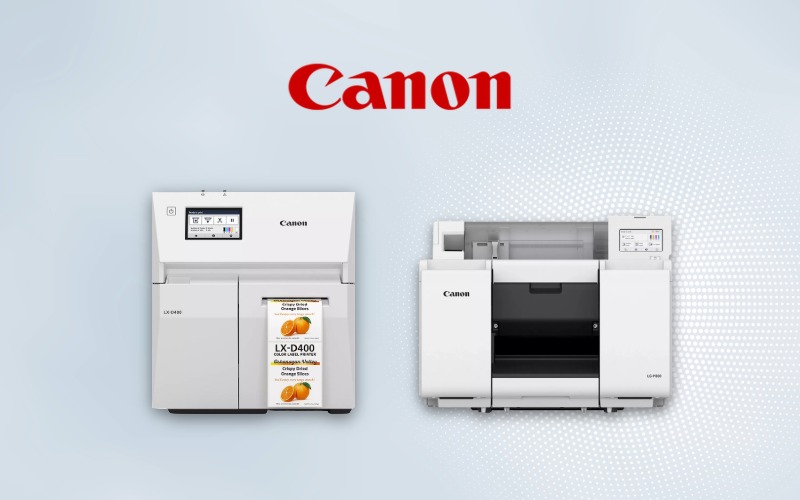
Canon is joining our product line with two new color label printer models: the LG-P800 and the LX-D400.
As a leading Japanese brand, Canon designs high-performance machines tailored for professionals, combining precision and reliability.
Compatible with both dye-based and pigment-based inks, Canon label printers print effortlessly on rolls or fanfold paper, with a matte or glossy finish.
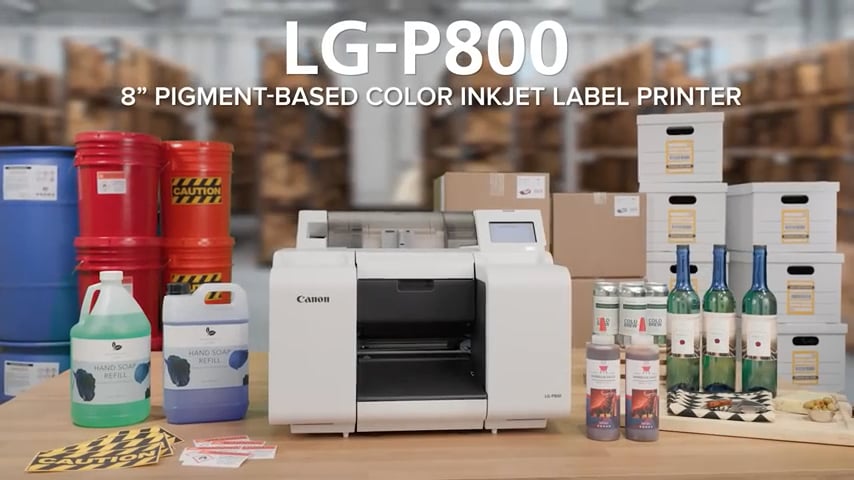
Canon LG-P800: versatility and large format
Designed to meet a wide variety of labeling needs, the LG-P800 combines high print quality with an efficient workflow.
It is equipped with innovative systems that reduce ink waste and ensure consistent print quality.
Its prints are exceptionally sharp thanks to high resolution. It prints edge-to-edge on media ranging from 5 to 21.6 cm wide.
Its pigment-based inks are water-resistant, smudge-proof, and fade-resistant, ensuring durable labels suitable for a wide range of environments.
- Print speed: up to 47 mm/s
- Print width: up to 210 mm
- Print resolution: up to 1200 dpi
Ideal for the food and beverage, cosmetics, packaging, product identification, and retail industries.
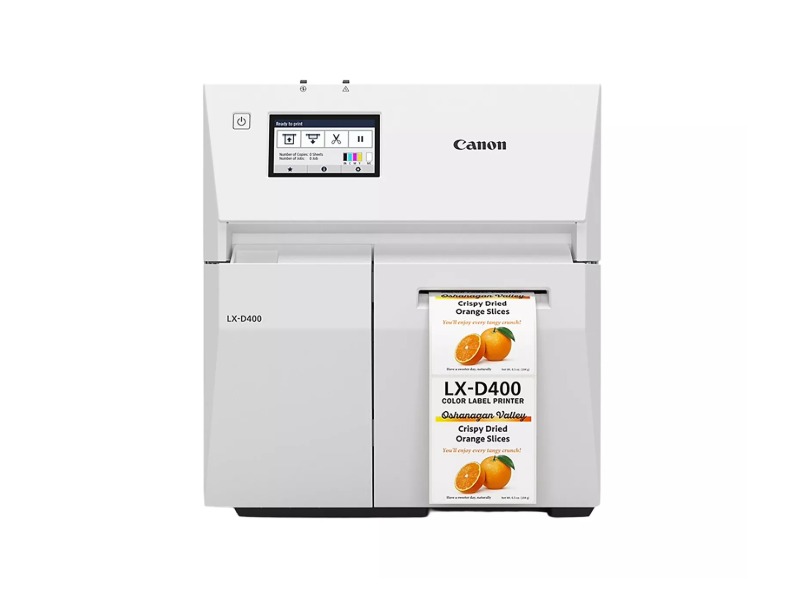
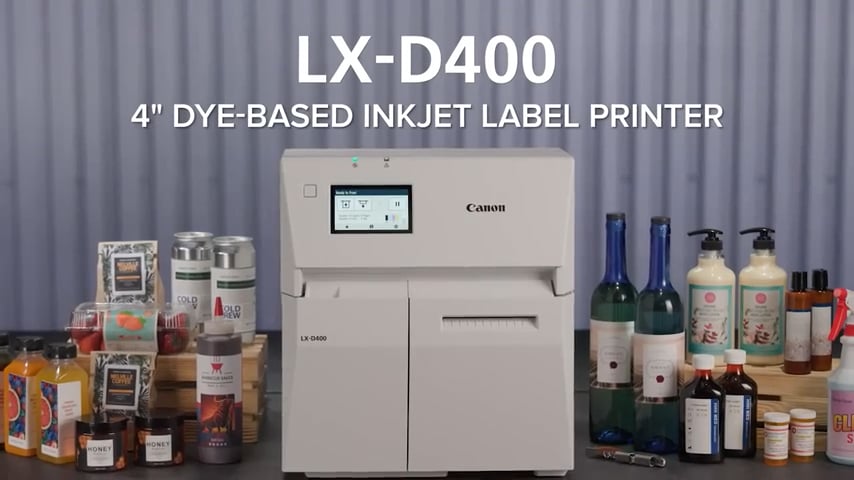
Canon LXD400: speed and reliability
Compact and fast, the LX-D400 is a dye-sublimation label printer designed for high-volume production. It prints continuously at speeds of up to 30 cm per second, in high resolution (1,200 Ć 1,200 dpi) and edge-to-edge, on matte, glossy, or synthetic media.
Easy to use thanks to its touchscreen, it can also accommodate a module RFID UHF * an optional feature that allows you to print and encode labels simultaneously for real-time inventory management.
- Print speed: up to 300 mm/s
- Print width: up to 110 mm
- Print resolution: up to 1200 dpi
Ideal for logistics, distribution, retail, and inventory management.
More details in videos :
* RFID (radio-frequency identification) allows data to be read remotely from a chip embedded in the label. Without the module, label printing and chip encoding are performed in two separate steps. With the module, the LX-D400 performs both tasks in a single pass, without slowing down production and ensuring that the print data matches the chip data.